Blindfolds
Bird BoxBlindfolds are the practical barrier between Malorie and the sight that can destroy a person’s mind, but they are more than equipment: they organize the family’s rules, movement, and knowledge of the world. For four years they help keep the children alive without ever letting them see beyond the house. On the river, the same cloth that protects them becomes a source of strain and fear; at the journey’s end, Malorie removes it only after reaching safety, then chooses to close her eyes again and continue forward.
Design and Use in the House
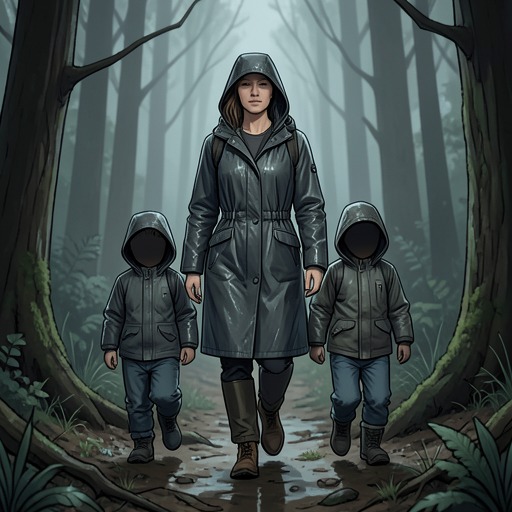
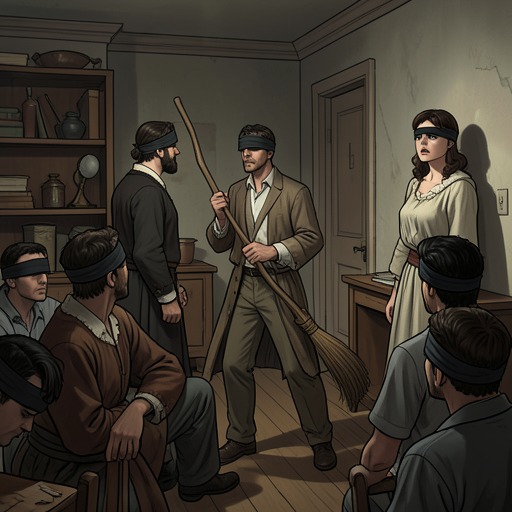
The blindfolds belong to a household built around controlling sight. The windows are boarded over, and wires running from beneath the back door connect to amplifiers in the first-floor bedrooms, alerting Malorie and the children to sounds outside. When the family does go out, they are blindfolded. The children have never seen the world beyond their home, even through a window, and Malorie has not looked outside for more than four years.
The bedroom makes that protection visible in a second form. A single window is covered with blankets thick enough to keep out sunlight, while black domes of cloth and chicken wire cover the children’s sleeping spaces. The wire once fenced a small garden near the backyard well; now it acts as armor against what the children might see. Malorie kneels to loosen it from the nails in the floor and brings out the blindfolds as the children wake. The arrangement is not a temporary precaution for a dangerous outing: it is built into where they sleep and how they begin each day.
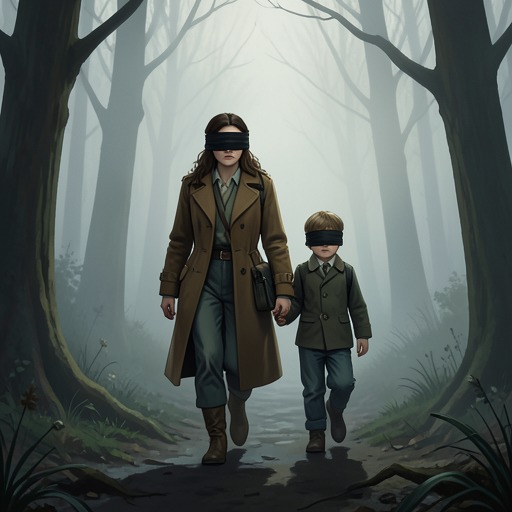
Malorie teaches the blindfolds as an absolute rule, not a negotiable instruction. She warns the Boy and Girl never to remove them, under any circumstances, and threatens to hurt them if they do. She needs them to understand that survival depends on obeying even when she is not beside them to intervene. At the same time, the cloth does not make them passive. Malorie asks for their ears: while they travel on the river, they must listen beyond the water and woods, then tell her if they hear an animal on the banks or anything in the water. The blindfold establishes the boundary of what they cannot know by sight; listening becomes the skill through which they navigate what lies beyond it.
The Blindfolded World and Its Strain
The river journey tests the protection in motion. Rowing blindfolded is harder than Malorie imagined: the boat repeatedly strikes the banks and remains stuck for minutes at a time. While it is trapped, she imagines unseen hands reaching for the children’s covered eyes, with fingers rising from the water or the mud where river meets earth. The children do not scream or complain. Their patience is part of the discipline the blindfolded life has taught them, but it also makes the scene unsettling: the danger is not something they can confirm by looking, and their mother must keep moving without that certainty.
The children’s hearing offers real assistance, though it cannot replace sight in every respect. When the boat needs freeing, the Boy stands and pushes against a mossy trunk; Malorie resumes paddling. Birds sing in the trees, animals move among the thick foliage, and fish splash from the water. The world is present to the family as sound, but never as an image. The question of how far a person can hear recurs against the limits of that arrangement: listening can register life and warn of danger, yet it cannot show Malorie what is coming.
The cloth is also physically uncomfortable. During the escape, the Boy tells Malorie that his blindfold hurts. She tells him to scoop river water carefully and rub the painful place without taking the blindfold off. The instruction makes the governing trade-off concrete: even pain must be managed while the protection remains in place. Later, as Malorie continues rowing with a severe shoulder wound, she remembers years of injuries sustained while living under these constraints, including falls on the cellar stairs, a head struck against a rock while carrying a bucket from the well, a possible broken wrist, and a chipped tooth. The blindfold does not itself cause every injury, but life organized around moving without sight makes ordinary tasks dangerous and makes stopping for help difficult.
The exhaustion is not only bodily. After years in which the permitted sights have been limited to walls, blankets, stairs, carpet, stains, buckets, tools, food, candles, chairs, and the faces of housemates and children, the possibility of opening her eyes carries its own threat. Malorie wonders whether she is prepared for the colors and multitude of sights waiting beyond the blindfold. The protection has narrowed her visual world so completely that sight, once ordinary, has become an anticipated shock. The cloth guards against the creatures, but its long use also marks the distance between the life she remembers and the one she has had to construct.
Rules Under Threat on the River
When another boat draws near and its engine comes level with Malorie’s, she orders the children not to remove their blindfolds. The other boat does not pass. Malorie believes its occupant can see them, and the encounter sharpens the difference between the protected family and an exposed stranger. She continues to insist on the rule even as the unknown person’s presence makes the river feel newly dangerous.
That danger becomes more immediate after the man in the boat goes mad. Malorie paddles furiously, feels that her own blindfold is not tight enough, and shouts again for the children to keep theirs on. She demands an answer and hears the Boy and Girl confirm that they understand. Her commands preserve the routine at precisely the moment when terror threatens to make it break down. The blindfold is not simply worn; it must be kept in place through repeated decisions, spoken instructions, and the children’s obedience.
The cloth’s meaning accumulates through other threats along the route. Malorie recalls the wolf that struck, the mad man in the boat, and birds that went mad; she also fears that a creature has toyed with the family’s only form of protection. In this sequence, the blindfold stands between the family and a danger that may approach through different bodies and circumstances, while offering no assurance that the danger will stay at a distance. Malorie can feel the cloth and know what it has meant to her, but she cannot see whether it is enough.
The Moment of Choice
At the river channels, the blindfold becomes the focus of a deliberate choice rather than a rule applied automatically. Malorie turns to face the channels and opens her eyes. Color overwhelms her at first; she squints and gasps, then continues looking, drawn to the sight even as she understands that she cannot keep it. Tom’s voice urges her onward. She closes her eyes, returns to the darkness she knows, and resumes rowing. The sequence gives the blindfold two opposed meanings at once: it has hidden the world for years, but it also lets Malorie choose when to stop looking and return to the task of getting the children through.
The escape does not end when she sees the channels. The rowboat crashes into a fence, which Malorie recognizes as the trigger for Rick’s alarm. She remains blindfolded when Constance calls out and asks whether her eyes are open; Malorie answers that she is wearing a blindfold. The answer keeps the distinction clear between reaching a place of refuge and deciding that sight is safe. Inside the facility, Constance says it is all right to open their eyes. Malorie refuses to expose the children first: she grips them and says that she will do it before them. Only then does she tug away her own blindfold and slowly open her eyes in the bright school hallway.
Once the family is safe, Malorie removes the blindfolds from the children. Their eyes blink and strain against the light; the Boy and Girl stare quietly, unsure where they are, looking to Malorie for guidance. This is the first place they have seen outside the house in their entire lives. The removal is therefore not a small change of clothing but the ending of a childhood defined by enforced darkness. The cloth has protected them, while also keeping their knowledge of the world within the limits set by their mother’s warnings.
Protection, Memory, and Survival
The blindfold’s final importance lies in the contrast between what it prevents and what it makes possible. It blocks the sight that can bring madness, yet leaves the family dependent on hearing, touch, memory, and carefully rehearsed instructions. It turns a simple object into a daily practice: sleeping beneath wire and cloth, covering the eyes before travel, monitoring sounds, enduring pain, and refusing to look even when fear demands confirmation. The family’s survival depends not on one decisive act of covering their eyes but on maintaining this system across years and under pressure.
For Malorie, the cloth also holds the history of what survival has cost. At the channels she recognizes it as the boundary between the world she fears and the world she has nearly forgotten how to see. She opens her eyes briefly, then closes them and keeps rowing; at Rick’s school she removes the blindfold only after reaching shelter, and takes the children’s away once she can protect them there. Its meaning changes with the circumstances, but its governing tension remains: sight may promise access to the world, while refusing sight is what has carried the family toward a chance to live in it.